

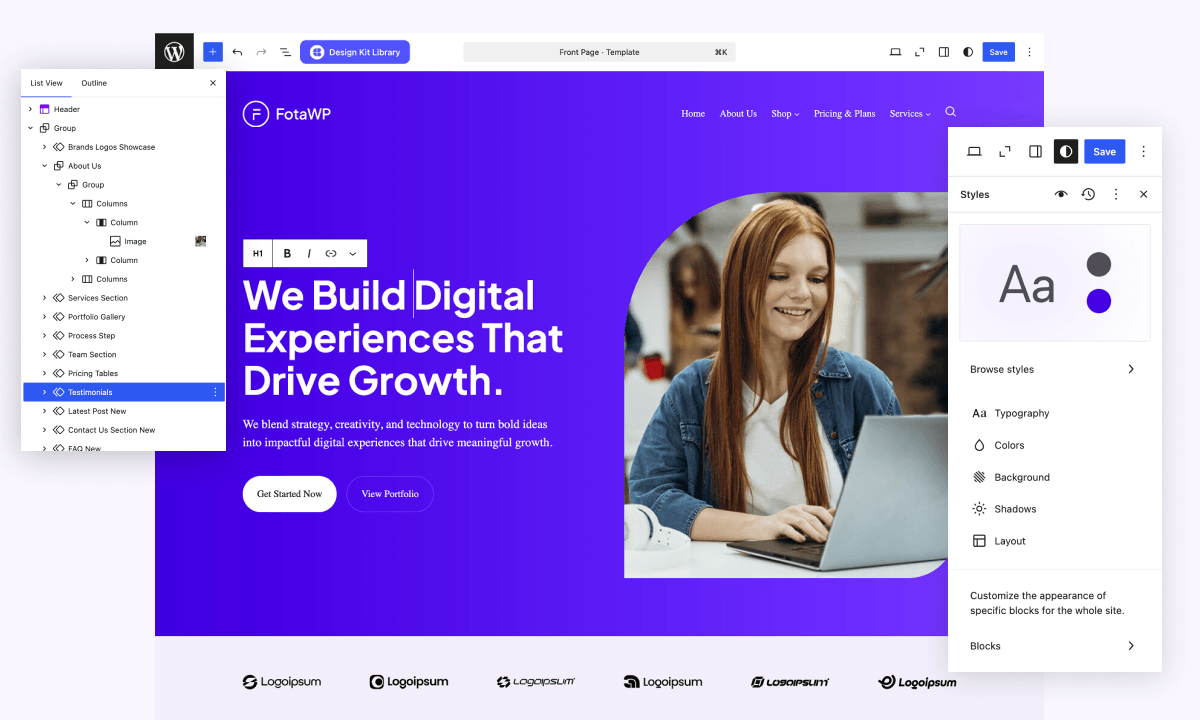
WordPress website building has changed significantly over the last few years.
For a long time, creating a WordPress website meant working with several separate systems. You wrote pages and posts in the editor, customized colors and layouts through the theme’s options or Customizer, managed menus elsewhere, and often relied on plugins or custom CSS when you wanted to change the header, footer, or page structure.
That model is changing.
With WordPress Full Site Editing (FSE) and block themes, much more of a website can be built and customized using the same block-based approach that WordPress users already know from creating pages and posts.
You can edit a header with blocks. You can build a footer with blocks. You can modify templates for posts and archives, manage navigation, establish typography and colors, and reuse complete design sections through patterns.
The result is not simply another page-building interface. It is a different way of thinking about WordPress website customization.
Instead of asking, “Where is the theme setting for this?”, you increasingly work directly with the structure of the website.
This guide explains what WordPress Full Site Editing is, how the Site Editor works, how FSE relates to Gutenberg and the Block Editor, and how block themes, templates, template parts, patterns, blocks, and Global Styles fit together.
It also covers practical FSE workflows, benefits, limitations, best practices, and resources from CozyThemes for users who want to build with the modern WordPress block ecosystem.
What Is WordPress Full Site Editing?
WordPress Full Site Editing is a block-based approach to customizing an entire WordPress website, including its templates and structural areas, rather than limiting block editing to the content inside individual pages and posts.
With a compatible block theme, users can work with areas such as:
- Headers
- Footers
- Navigation
- Homepage layouts
- Single post templates
- Page templates
- Archive layouts
- Search results
- 404 pages
- Typography
- Colors
- Spacing
- Layout settings
- Block styles
The important change is not simply that WordPress gives you more settings. It is that more of the website can be edited through a shared block-based system.
WordPress introduced block themes and the Site Editor as part of its broader move toward block-based site editing. Block themes are designed around blocks for areas of the site that were traditionally controlled primarily through theme files or theme-specific settings.
Why Does Full Site Editing Matter?
Consider a simple example.
You want to change the footer of a traditional WordPress website.
Depending on the theme, you might need to:
- Find a footer setting
- Open the Customizer
- Change a widget area
- Install another plugin
- Add custom CSS
- Edit theme files
With a block theme, the footer can be a template part that you open and edit visually using blocks.
The same idea applies to headers, templates, navigation, and site-wide design.
This makes FSE particularly useful for people who want more direct control over their website without needing to edit theme files for every visual change.
It is not a replacement for every WordPress workflow, and classic themes remain useful. But for anyone starting to work with modern WordPress, understanding Full Site Editing is increasingly important.
What Is the WordPress Site Editor?
The WordPress Site Editor is the interface through which you can customize the structure and design of a block-based WordPress website.
When a compatible block theme is active, you can generally access it from:
WordPress Dashboard → Appearance → Editor
The Site Editor brings together several areas that were traditionally handled separately, including:
- Styles
- Templates
- Template Parts
- Patterns
- Navigation
- Pages
- Site-wide design settings
The exact interface and available capabilities can vary with the WordPress version and active theme, but the underlying idea remains the same: the Site Editor lets you work on the site itself, not just the content inside a page.
A useful way to understand the terminology is:
Full Site Editing
The broader block-based approach to site-wide editing.
Site Editor
The interface used to customize the website.
Block Theme
The theme foundation designed for the Site Editor.
Templates
Layouts for different types of content or site views.
Template Parts
Reusable structural sections such as headers and footers.
Patterns
Reusable collections of blocks arranged into useful layouts.
Blocks
The individual building components.
Global Styles
The visual system that controls site-wide design settings.
Once these relationships become clear, FSE becomes much easier to understand.
Full Site Editing vs Gutenberg vs Block Editor vs Site Editor
WordPress terminology can be confusing because several terms describe different parts of the same evolution.
Here is the simplest distinction:
| Term | What it means | Primary purpose |
|---|---|---|
| Gutenberg | The broader WordPress project behind the evolution of block-based editing | Developing the modern WordPress editing experience |
| Block Editor | WordPress’s block-based content editor | Creating and editing posts, pages, and content |
| Site Editor | The interface for editing site structure and design | Templates, styles, navigation, template parts, and more |
| Full Site Editing | The broader approach to block-based site customization | Bringing blocks into more areas of the website |
| Block Theme | A theme built around blocks and editable templates | Providing the foundation for the Site Editor |
Gutenberg
Gutenberg is the broader project associated with the development of WordPress’s block-based editing experience.
It is therefore broader than simply the editor you see when creating a post.
WordPress Block Editor
The Block Editor is the content editing interface used for posts, pages, and other supported content.
A paragraph, heading, image, button, gallery, list, or other element can be represented as a block.
WordPress Site Editor
The Site Editor takes the block concept beyond individual content.
It lets you work with the structure and design of the website itself.
Full Site Editing
FSE describes the broader approach of using blocks to customize the website, including areas historically controlled by the theme.
Block Theme
A block theme provides the foundation that makes this site-wide block editing workflow possible.
So, while these concepts are closely connected, they are not interchangeable.
Gutenberg is the project. The Block Editor edits content. The Site Editor edits the site. Full Site Editing describes the broader approach. A block theme provides the foundation.
That distinction alone clears up much of the confusion around modern WordPress terminology.
How Does Full Site Editing Work?
The easiest way to understand FSE is to think of a WordPress website as a collection of reusable building pieces.
A block theme provides the foundation.
The Site Editor gives you access to the site’s structure and design.
Templates determine how different types of content are displayed.
Template Parts handle recurring areas such as headers and footers.
Blocks provide the individual building components.
Patterns combine blocks into reusable layouts.
Global Styles establish consistent design rules.
A simplified model looks like this:
Block Theme
↓
Site Editor
↓
Templates + Template Parts
↓
Blocks + Patterns
↓
Global Styles
This is not a strict technical hierarchy. These components interact with one another.
For example, a Single Post template might contain:
- A Header template part
- Post Title block
- Post Featured Image
- Post Content block
- Author information
- Related content
- A Footer template part
The same header and footer can be reused across multiple templates.
That means you are not designing every page as an isolated object. You are creating a system of reusable components.
This is one of the most important ideas behind Full Site Editing:
Build the structure once where possible, then reuse and customize it instead of rebuilding the same elements repeatedly.
What Can You Customize With Full Site Editing?
The exact controls depend on the WordPress version, block theme, and plugins you use, but FSE can provide control over much more of a website than traditional content editing alone.
Header
A block-based header can contain:
- Site Logo
- Site Title
- Navigation
- Search
- Buttons
- Social Icons
- Contact information
You can change the arrangement, spacing, typography, colors, and other available settings directly through blocks.
Footer
A footer can contain:
- Logo
- Navigation
- Contact information
- Social links
- Newsletter signup
- Calls to action
- Legal links
Because footers are commonly implemented as template parts, you can reuse the same structure across different templates.
Navigation
The Navigation block brings site navigation into the block-based editing environment.
This makes navigation part of the overall design system instead of treating it as an isolated theme setting.
Homepage
You can construct a homepage using blocks and patterns.
For example:
Hero → Services → About → Testimonials → Projects → CTA → Footer
You can then adjust the layout without being locked into the original arrangement provided by the theme.
Blog Archive
An archive template can determine how posts are presented.
You can control the placement of:
- Featured images
- Titles
- Excerpts
- Dates
- Authors
- Categories
- Pagination
- Grid or list layouts
Single Post Template
A Single Post template can create a consistent reading experience:
Featured Image → Title → Metadata → Content → Author → Related Posts → Comments
This means you don’t have to manually rebuild the same structure every time you publish an article.
Search and 404 Pages
You can also create more useful search and 404 experiences.
For example, a 404 page could include:
- A helpful message
- Search
- Recent posts
- Popular pages
- Main navigation
- A link back to the homepage
Typography, Colors, Spacing, and Layout
Global Styles can help establish consistent typography, colors, spacing, and layout rules throughout the site.
This is where FSE moves beyond page design and starts functioning more like a website-wide design system.
What Is a WordPress Block Theme?
A block theme is a WordPress theme that uses blocks for its templates and site structure, allowing users to edit areas such as headers, footers, navigation, and content through the Site Editor.
Block themes are central to the FSE experience.
Traditional themes generally rely on PHP templates and theme-specific customization interfaces.
Block themes move more of the site’s presentation structure into the block system.
Block Themes vs Classic Themes
| Block Theme | Classic Theme |
| Uses block-based templates | Primarily uses PHP templates |
| Designed for Site Editor workflows | Traditionally uses Customizer/theme options |
| Headers and footers can be edited with blocks | Structural areas often depend on theme files/settings |
| Uses patterns and template parts | May use widgets, theme options, or PHP template parts |
| Global Styles can provide site-wide design controls | Styling often relies on theme settings and CSS |
| Built around the modern block ecosystem | Established and still widely used |
This does not mean classic themes are obsolete.
A classic theme may be perfectly appropriate for an existing website, especially if the site depends on a mature theme-specific workflow or custom development.
The distinction is primarily about how the website is built and maintained.
If your goal is to use the WordPress Site Editor for site-wide customization, however, a block theme is the natural starting point.
Full Site Editing Themes From CozyThemes
Once you understand block themes, the next question is practical: where do you start?
A good FSE theme can give you the structure, templates, patterns, and visual direction you need without forcing you to build everything from a blank site.
CozyThemes creates niche-focused WordPress themes built around Full Site Editing, block patterns, templates, and modern WordPress website building. Its collection covers SaaS, business, ecommerce, publishing, hospitality, interior design, home services, and other common website needs.
Here are some notable CozyThemes FSE-oriented themes and their best use cases:
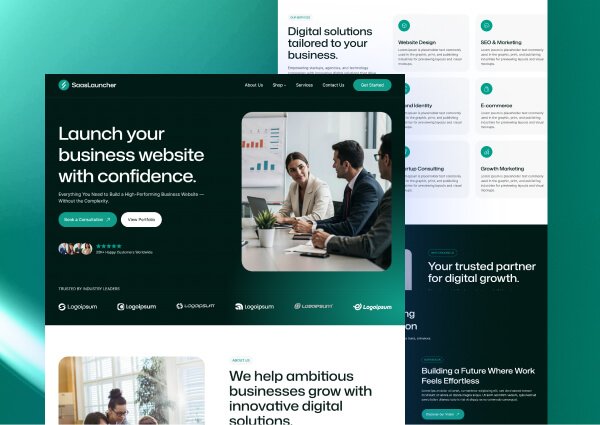
SaasLauncher
Best for: SaaS startups, technology companies, digital products, software businesses, agencies, and modern business websites.
SaasLauncher is designed around the needs of SaaS and technology businesses, with ready-made sections and starter layouts that help create product-focused websites faster. It works well for startup websites, software landing pages, digital agencies, and businesses that need a modern, flexible foundation.
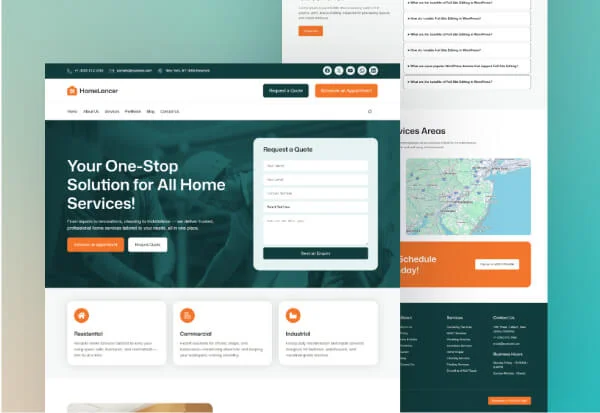
Homelancer
Best for: Home service businesses, contractors, repair companies, maintenance providers, and local service professionals.
Homelancer provides a business-focused foundation for home service websites. It is suited to businesses that need to present services, projects, pricing or packages, customer trust signals, and clear calls to action while maintaining control over the website through the block-based editing experience.
WoxStore
Best for: WooCommerce stores, online retailers, fashion stores, electronics stores, home products, and general ecommerce.
WoxStore is built around WooCommerce and Full Site Editing, giving store owners a flexible starting point for product and shop layouts. Its ready-made demos and ecommerce-focused structure make it useful when the website needs to combine product presentation with customizable site-wide design.

Orakus
Best for: Interior designers, home décor businesses, creative agencies, designers, portfolios, and visual brands.
Orakus is focused on image-led interior design and home décor websites. It provides ready-made sections and starter layouts that can be adapted for agencies, designers, décor businesses, and other visually driven websites.

JetNews Magazine
Best for: News websites, online magazines, blogs, publishers, and content-heavy websites.
JetNews Magazine is designed around editorial publishing, with templates and layouts suited to articles, archives, categories, and content presentation. It is a practical starting point for publishers who need a structured magazine-style website with FSE customization.

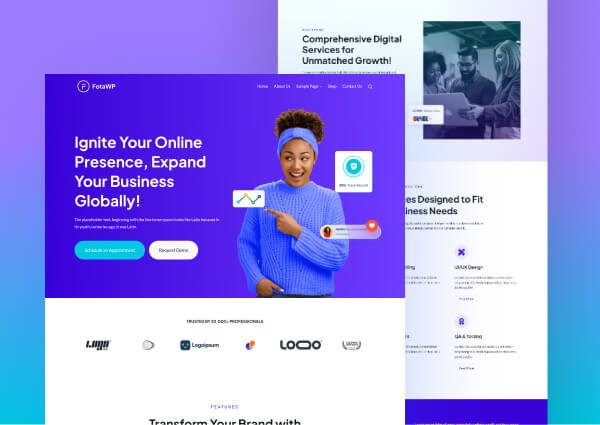
FotaWP
Best for: Small businesses, freelancers, agencies, portfolios, and multipurpose websites.
FotaWP is designed as a broader-purpose theme for users who need flexibility across different website types. Its collection of block patterns makes it useful when the goal is to create a professional site without committing to one specific niche.
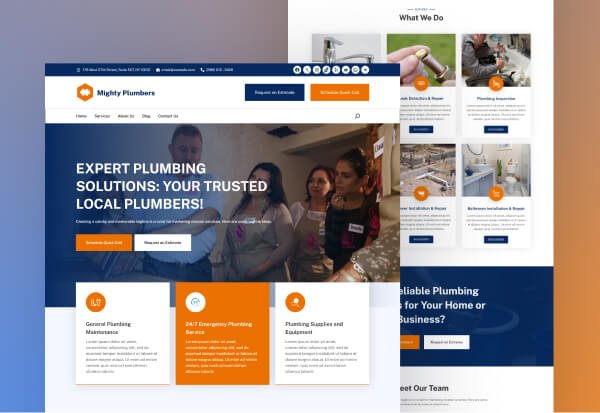
Mighty Plumbers
Best for: Plumbing businesses, contractors, repair companies, and related home service providers.
Mighty Plumbers provides a niche-focused foundation for plumbing and service businesses. It can help organize services, business information, calls to action, and other customer-focused sections while retaining the customization benefits of FSE.
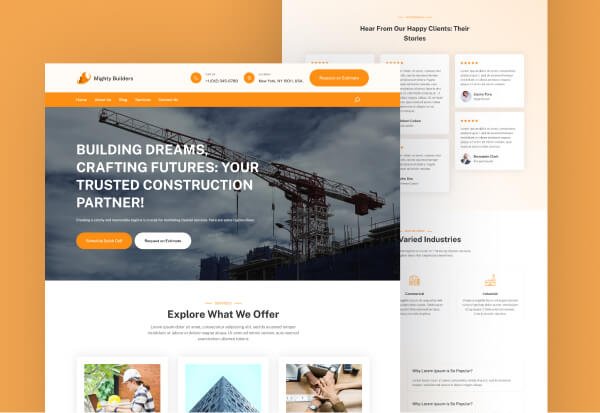
Mighty Builders
Best for: Construction companies, builders, contractors, construction agencies, and project-based businesses.
Mighty Builders focuses on construction websites that need to showcase services, projects, capabilities, and completed work. It combines a niche-specific starting point with block-based customization.
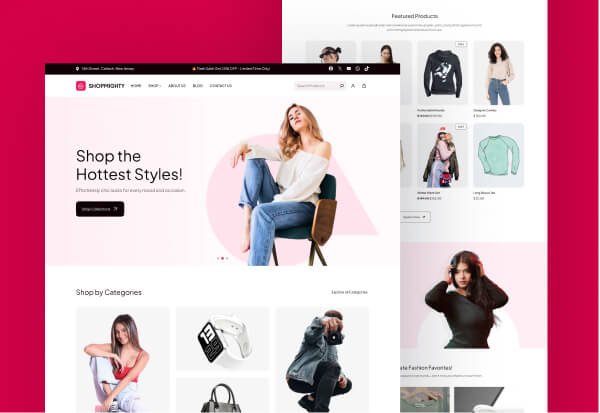
Shopmighty
Best for: WooCommerce stores across fashion, electronics, home products, lifestyle, and general retail.
Shopmighty is a flexible WooCommerce FSE theme designed for stores that want a ready-made ecommerce foundation while retaining broad control over layouts, templates, colors, typography, and content.
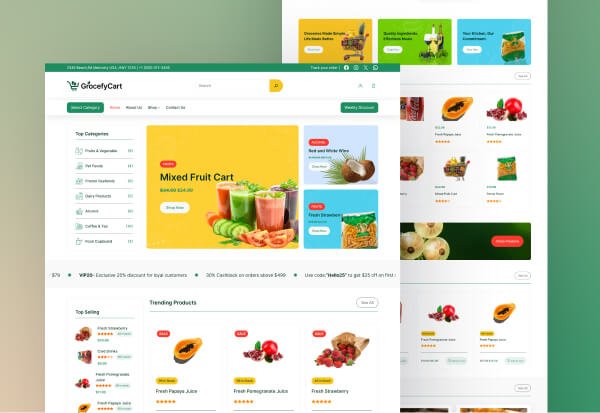
GrocefyCart
Best for: Online grocery stores, supermarkets, grocery delivery businesses, and food ecommerce.
GrocefyCart is tailored to grocery ecommerce, giving businesses a starting point for product organization, category presentation, shopping journeys, and store-focused layouts.
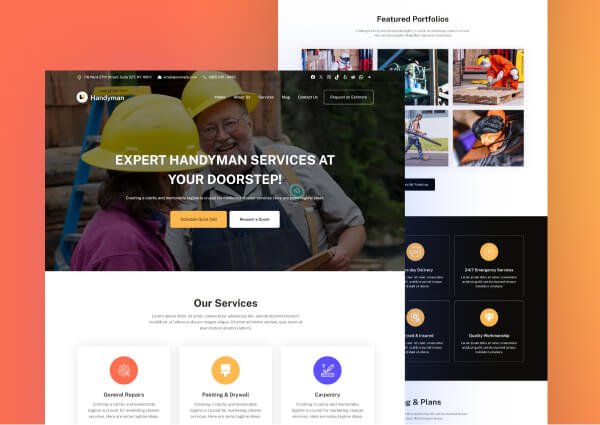
Handyman Blocks
Best for: Handymen, repair businesses, maintenance providers, home improvement companies, and local service professionals.
Handyman Blocks is designed around home service websites that need to explain services clearly and encourage visitors to make contact. Its ready-made sections provide a useful starting point while remaining customizable through the block-based workflow.
How to Choose an FSE Theme
Don’t choose a block theme simply because its demo looks good.
Look at:
- Whether the theme matches your niche
- Available templates
- Quality of patterns
- Typography
- Global Styles
- Responsive behavior
- Plugin compatibility
- Ecommerce support if needed
- Documentation
- Update history
- Support
A niche-focused theme can save substantial time because the basic information architecture and design direction are already closer to your actual business.
Explore CozyThemes’ Full Site Editing WordPress Themes
WordPress Templates Explained
A WordPress template is essentially a layout blueprint for a particular type of content or site view.
Common examples include:
- Single Post
- Page
- Archive
- Search
- 404
- Front Page
- Index
Consider a blog.
You might want every article to follow this structure:
Header
↓
Featured Image
↓
Post Title
↓
Author + Date
↓
Post Content
↓
Related Posts
↓
Comments
↓
Footer
Rather than manually constructing this layout for every article, a Single Post template can establish the common structure.
The individual article remains the content.
The template determines how that content is presented.
This separation is one of the reasons templates are so useful for content-heavy websites.
What Are Template Parts?
Template parts are reusable groups of blocks used for recurring structural areas.
Common examples include:
- Header
- Footer
- Sidebar
- Comments section
- Other reusable site sections
Imagine your website has five different templates.
Instead of recreating the header five times, those templates can use the same Header template part.
If you later change the header, you can update the reusable component instead of manually editing every template.
The simplest distinction is:
A template defines a layout for a content type or site view. A template part is a reusable section inside those layouts.
This makes template parts especially useful for maintaining consistency across a large website.
WordPress Block Patterns Explained
A block pattern is a predefined collection of blocks arranged into a reusable design layout.
Patterns are one of the most practical parts of the WordPress block ecosystem because they allow you to start with a complete section instead of an empty canvas.
For example, a testimonial section might contain:
- Heading
- Introductory text
- Customer quote
- Customer image
- Name
- Company
- Background
- Spacing
- Responsive layout
Instead of creating all of that manually, a pattern can provide the structure.
You then replace the content and adapt the design.
Why Patterns Matter
Patterns are useful for:
- Hero sections
- Services
- Testimonials
- Pricing
- Team sections
- Portfolios
- FAQs
- Contact sections
- Calls to action
- Feature sections
- Newsletter sections
They are especially valuable when building multiple pages because they provide consistency without forcing every page to look identical.
Blocks vs Patterns vs Template Parts vs Templates
| Component | What it does | Example |
| Block | Individual building unit | Heading, Image, Button |
| Pattern | Collection of blocks forming a reusable layout | Hero section |
| Template Part | Reusable structural site section | Header |
| Template | Layout for a content type or site view | Single Post |
A useful way to remember the difference:
Blocks build. Patterns accelerate. Template Parts repeat. Templates structure.
Cozy Blocks: Extend Full Site Editing and Gutenberg
A block theme provides the foundation for FSE, but the core WordPress block collection may not always provide every component you need.
That is where a block extension can become useful.
Cozy Blocks extends the WordPress Block Editor and Site Editor with 50+ advanced blocks, 700+ ready-made patterns, and 50+ complete FSE homepage templates. The plugin is designed specifically for modern block-based WordPress websites and works within the native block editing workflow.
Think of the relationship this way:
Block Theme = foundation
Site Editor = workspace
Cozy Blocks = additional building toolkit
This distinction is important. Cozy Blocks does not need to replace the Site Editor to be useful. Its purpose is to give users more building components and ready-made designs while continuing to work with WordPress’s block-based approach.
What Can You Build With Cozy Blocks?
The plugin includes advanced functionality for areas such as:
- Navigation
- Content sections
- Testimonials
- Team sections
- Pricing
- Portfolios
- Galleries
- Posts
- WooCommerce
- Popups
- Social content
- Responsive visibility
- Animation
- Typography
The current WordPress.org listing describes more than 50 advanced blocks and highlights features including WooCommerce blocks, post and magazine blocks, sliders, team and testimonial blocks, pricing tables, portfolio tools, popup functionality, responsive visibility, animations, Google Fonts, tabs, accordions, counters, progress bars, and advanced galleries.
High-Impact Cozy Blocks and Features
Some of the most useful categories for an FSE website include:
Advanced Mega Menu
Useful for larger websites with multiple services, product categories, resources, or navigation levels.
Advanced Tabs
Organize related information into compact sections without creating unnecessarily long pages.
Accordion
Particularly useful for FAQs, specifications, service details, and expandable information.
Slider and Carousel Blocks
Present featured content, images, testimonials, or promotional material in interactive layouts.
Advanced Gallery
Useful for portfolios, photographers, designers, agencies, and image-heavy websites.
Post Grid and Carousel
Create structured displays of blog posts, featured articles, or other dynamic content.
Team Block
Present team members in a consistent professional layout.
Testimonial Block
Showcase customer feedback as a dedicated social-proof component.
Pricing Table
Present plans, packages, or service options in a clear comparison layout.
Portfolio Block
Create project showcases for designers, agencies, photographers, developers, and other creative professionals.
Popup Builder
Build promotional, announcement, or lead-generation experiences where appropriate.
Social Media and Share Blocks
Connect website content with social profiles and sharing functionality.
Counter
Highlight measurable achievements such as customers, projects, downloads, or years of experience.
Progress Bar
Present percentages, skills, progress, or other measurable information visually.
Tabs, Accordion, Counter, and Progress
These can be combined to create richer content sections without moving away from the Block Editor.
Responsive Visibility
Control whether specific content appears in particular responsive contexts when the design requires it.
Animation and Hover Effects
Add interaction where it supports the user experience rather than simply adding visual noise.
The Cozy Blocks Design Library
The value of Cozy Blocks goes beyond individual blocks.
Its design library includes 700+ block patterns across 20+ categories, covering areas such as hero sections, page headers, footers, services, pricing, testimonials, team sections, portfolios, blog layouts, calls to action, FAQs, contact sections, newsletters, statistics, brand showcases, and WooCommerce sections.
It also includes 50+ complete homepage templates for 12 niches, including:
- Agency
- Author & Writer
- Blog & Magazine
- Business
- Charity & Nonprofit
- Education
- Home Services
- Restaurant & Hotel
- Photography
- Portfolio
- SaaS & Startup
- WooCommerce Store
This creates three practical levels of website building:
Start with a complete template
→ Get the overall website structure in place.
Start with a pattern
→ Build an individual page from ready-made sections.
Start with an individual block
→ Create a more specific component yourself.
That makes the toolkit useful for beginners who want a head start and experienced WordPress users who want to build faster.
Cozy Blocks is specifically designed for block-based themes and the WordPress Site Editor; its current WordPress.org listing notes that it works with block-based FSE themes rather than classic PHP themes.
Explore Cozy Blocks on WordPress.org
Global Styles in WordPress
Global Styles are one of the most important pieces of the modern WordPress design system.
Instead of manually styling every heading, button, paragraph, or section, you can establish site-wide visual rules.
Depending on the theme and WordPress version, this can include:
- Typography
- Font families
- Font sizes
- Colors
- Backgrounds
- Layout
- Spacing
- Block-specific styles
For example, suppose your brand uses:
- One primary color
- One secondary color
- A specific heading font
- A specific body font
- Consistent button styling
- A defined content width
Rather than reproducing those decisions manually on every page, Global Styles can establish them centrally.
This makes the website easier to maintain and helps prevent a common problem: every page slowly developing a slightly different visual style.
Global Styles Are More Than Colors
It is easy to think of Global Styles as a color-setting tool.
They are much broader.
A well-designed block theme can use the site’s style system to establish a coherent design language covering typography, colors, spacing, layout, and block-level appearance.
This is particularly important for larger websites.
When the design system is established first, individual pages become easier to build because you are working within an existing visual framework.
How to Customize a WordPress Website With the Site Editor
Once the terminology makes sense, the actual workflow becomes much simpler.
1. Install a Compatible Block Theme
Start with a block theme that fits the website’s purpose.
The theme determines much of your starting structure, templates, patterns, and design system.
2. Open Appearance → Editor
This opens the Site Editor when the active theme supports it.
3. Explore Before Editing
Look through:
- Styles
- Templates
- Template Parts
- Patterns
- Navigation
Understand how the theme is organized before making major changes.
4. Establish Global Styles
Set your core:
- Colors
- Typography
- Spacing
- Layout
- Button styles
Doing this early prevents inconsistent styling later.
5. Customize the Header
Review the logo, navigation, spacing, typography, and primary call to action.
Don’t overload the header. It should help visitors understand the site and move around it.
6. Configure Navigation
Build the menu around the user’s priorities.
Not every page needs to appear in the main navigation.
7. Customize the Footer
Use the footer for secondary navigation, contact information, social links, supporting information, and useful calls to action.
8. Review Templates
Pay particular attention to:
- Front Page
- Page
- Single Post
- Archive
- Search
- 404
9. Use Patterns
Instead of creating every section from scratch, use patterns for recurring layouts.
10. Check Mobile Layouts
Review the site at different screen sizes.
Look for:
- Overflow
- Excessive spacing
- Tiny text
- Broken columns
- Difficult navigation
- Buttons wrapping badly
- Images affecting layout
11. Review Major Changes Before Publishing
Template and template-part changes can affect multiple pages.
Understand the scope of a change before saving it across the website.
How to Build a WordPress Website With Full Site Editing
The strongest FSE workflow starts with information architecture, not visual decoration.
Step 1: Plan the Site Structure
Start with the pages visitors actually need.
A service business might use:
Home → About → Services → Projects → Blog → Contact
A SaaS company might use:
Home → Features → Solutions → Pricing → Resources → Contact
An ecommerce store might use:
Home → Shop → Categories → Product → Cart → Checkout → Account
The exact structure depends on the business.
Step 2: Choose the Right Block Theme
Look for:
- Relevant templates
- Useful patterns
- Strong typography
- Responsive layouts
- Logical spacing
- Plugin compatibility
- Ecommerce support when needed
- Active maintenance
- Documentation
A beautiful screenshot is not enough.
Step 3: Establish the Design System
Set your:
- Brand colors
- Typography
- Heading hierarchy
- Content width
- Spacing
- Buttons
- Links
Step 4: Build the Global Shell
Create a consistent:
Header → Navigation → Main Content → Footer
Step 5: Configure Templates
Decide how different content types should appear.
Your blog may need separate layouts for:
- Single posts
- Categories
- Tags
- Search
- Archives
Step 6: Build Pages With Patterns
Use reusable sections for:
- Hero areas
- Services
- Features
- Testimonials
- Pricing
- Team
- FAQs
- CTAs
Step 7: Review SEO
Full Site Editing does not automatically make a website search optimized.
You still need:
- Descriptive page titles
- Logical heading hierarchy
- Useful content
- Internal links
- Descriptive image alt text where appropriate
- Crawlable navigation
- Good information architecture
- Proper indexation
- Structured data where appropriate
Step 8: Review Accessibility
Check:
- Heading structure
- Color contrast
- Keyboard navigation
- Link clarity
- Button labels
- Image alternatives
- Focus states
A beautiful website is not automatically an accessible website.
Step 9: Review Performance
Block-based websites still require performance discipline.
Optimize:
- Images
- Fonts
- Third-party scripts
- Plugins
- Page complexity
Avoid adding unnecessary visual effects simply because they are available.
Step 10: Test Before Launch
Test:
- Navigation
- Forms
- Search
- Links
- Ecommerce flows
- Mobile layouts
- Tablet layouts
- Desktop layouts
Then review the website as a visitor rather than only as the person who built it.
Benefits of WordPress Full Site Editing
FSE offers several practical benefits when used thoughtfully.
More Visual Control
You can work with headers, footers, templates, navigation, and other structural areas that traditionally required theme-specific settings or code.
Consistent Design
Global Styles, patterns, and template parts make it easier to maintain a coherent visual system.
Reusable Layouts
Patterns reduce repetitive work and make common page sections easier to reproduce.
Easier Site-Wide Changes
A well-structured template part can allow a single change to affect multiple templates.
Less Dependence on Code for Routine Changes
You can make many common design adjustments without editing PHP or CSS.
That does not eliminate the need for developers. It simply means developers do not have to handle every small visual adjustment.
A More Unified Workflow
The same block-based language can increasingly be used for content, layouts, templates, and site design.
For many site owners, that is the real advantage of FSE.
Limitations and Challenges of Full Site Editing
FSE is useful, but it is not perfect—and understanding its limitations makes you a better WordPress user.
There Is a Learning Curve
Terms such as:
- Template
- Template Part
- Pattern
- Global Styles
- Query Loop
- Block Theme
can be unfamiliar at first.
The learning curve is real, but it becomes much easier once you understand how the pieces connect.
Block Themes Differ
Two block themes can offer very different experiences.
One may provide extensive templates and patterns.
Another may be intentionally minimal.
The quality of the theme still matters.
Features Depend on Context
Available settings can vary according to:
- WordPress version
- Active theme
- Installed plugins
- Block support
- Theme configuration
Avoid assuming that every block theme exposes exactly the same controls.
Advanced Functionality May Still Need Code
FSE reduces the need for code for many visual tasks.
It does not eliminate development.
You may still need PHP, JavaScript, CSS, custom blocks, or plugins for:
- Complex integrations
- Specialized functionality
- Advanced business logic
- Custom APIs
- Complex ecommerce requirements
Classic Themes Still Have Their Place
If an existing classic theme works well and your team has an established workflow, there may be little reason to migrate simply because FSE exists.
Plugin Integration Can Vary
A plugin can work correctly with a block theme while still using its own interface.
For important plugins—especially ecommerce, forms, memberships, bookings, or advanced functionality—test compatibility before making a major theme change.
Theme Switching Requires Planning
Moving between themes can affect templates, styles, navigation, patterns, and presentation.
A theme migration should therefore be treated as a structural change, not just a cosmetic redesign.
Full Site Editing Best Practices
The best FSE websites are rarely the ones using the most features.
They are the ones using the right features consistently.
Start With a Strong Block Theme
Your theme establishes the starting point for the entire website.
Choose based on structure and maintainability, not just the demo.
Establish Global Styles Early
Set your visual foundation before customizing individual pages.
Use Patterns for Repeatable Designs
If a section is likely to appear several times, use a pattern instead of rebuilding it.
Keep Templates Organized
Don’t create custom templates simply because you can.
Create them when the content genuinely requires a different layout.
Keep Headers and Footers Focused
The header should help visitors navigate.
The footer should provide useful supporting information.
Neither should become a dumping ground for every available block.
Design for Mobile From the Beginning
Don’t wait until launch to discover that your desktop layout does not work on a phone.
Prioritize Accessibility
Good contrast, typography, heading structure, navigation, focus states, and keyboard behavior should be part of the design process.
Avoid Excessive Block Nesting
A layout with dozens of nested Groups and Columns can become difficult to maintain.
Use the simplest structure that solves the design problem.
Test Plugins
Especially when the website depends on WooCommerce, forms, memberships, bookings, or other important functionality.
Update Responsibly
Keep WordPress, themes, and plugins updated, but maintain backups and test major production changes.
Who Should Use WordPress Full Site Editing?
FSE can be a strong fit for many different users.
Bloggers
Create consistent post, archive, search, and category layouts while controlling typography and design.
Freelancers
Use reusable patterns and templates to build client websites faster.
Small Businesses
Make many visual changes without relying on a developer for every adjustment.
Agencies
Build reusable design systems and repeatable website structures.
Designers
Work visually with layouts, typography, colors, and components while staying within native WordPress.
Developers
Build block themes, custom blocks, patterns, templates, and sophisticated block-based experiences.
Content Creators
Maintain consistent branding while publishing regularly.
Nonprofits
Create reusable sections for campaigns, donations, events, programs, and calls to action.
Service Businesses
Build pages for services, projects, testimonials, team members, and contact information.
WooCommerce Stores
Use compatible block themes and WooCommerce blocks to customize store layouts and presentation.
When Might Another Workflow Be Better?
FSE may not be the ideal choice when:
- Your existing classic theme already works exceptionally well
- Your project depends heavily on theme-specific functionality
- Your development team has a mature custom-theme workflow
- A critical plugin has limited compatibility
- Your website requires highly specialized functionality
The right question is not:
“Is FSE better than everything else?”
It is:
“Does the block-based editing model fit how this website needs to be built, customized, and maintained?”
Is Full Site Editing the Future of WordPress?
It is better to look at WordPress’s current direction than to make absolute predictions.
WordPress continues to expand its block-based ecosystem through:
- Block themes
- Site Editor capabilities
- Templates
- Template Parts
- Patterns
- Global Styles
- Theme blocks
- Block APIs
That makes the block-based approach increasingly relevant for both WordPress users and developers.
This does not mean classic themes are disappearing overnight.
WordPress supports a huge ecosystem of existing websites, themes, plugins, and custom implementations.
Instead, think of FSE as an important part of WordPress’s modern editing direction.
For website owners, learning the Site Editor can mean greater control over the structure and design of a website.
For developers, it means understanding concepts such as block themes, templates, patterns, theme.json, template parts, and block development.
For agencies and freelancers, it can provide a more reusable way to build websites around consistent design systems.
The most useful approach is therefore not to treat FSE as a trend.
Learn how it works, understand where it is strongest, and use it when it fits the project.
Frequently Asked Questions About WordPress Full Site Editing
Full Site Editing is a block-based approach that lets users customize much more of a WordPress website—including templates, headers, footers, navigation, styles, and reusable sections—rather than limiting blocks to page and post content.
No. Gutenberg is the broader WordPress project associated with the development of block-based editing. The Block Editor is primarily used for content, while the Site Editor is used for site structure and design. FSE describes the broader approach to block-based site editing.
The Site Editor is the WordPress interface for editing site structure and design with blocks. Depending on the theme and WordPress version, this can include templates, template parts, navigation, patterns, styles, and pages.
For the full Site Editor experience, a block theme is the normal requirement. Block themes are specifically designed around block-based templates and site editing.
Yes. With a block theme, the header can be created and edited as a template part using blocks.
Yes. A footer can be created as a reusable template part and customized using blocks and available style settings.
Yes. Block themes can provide and support custom templates for different content types and site views.
Block patterns are predefined collections of blocks arranged into reusable layouts. You can insert a pattern and customize its content and appearance rather than creating the entire section manually.
Not universally.
Block themes are better suited to the Site Editor and modern block-based workflow. Classic themes remain useful for many established websites and specialized development workflows.
Yes. Block themes can use WordPress plugins, although the level of integration with the Site Editor varies from plugin to plugin.
It can be.
The terminology creates an initial learning curve, but once you understand blocks, templates, template parts, patterns, and Global Styles, the workflow becomes much easier to navigate.
Yes, but plan the change carefully.
Your content remains in WordPress, but the theme controls important presentation elements such as templates, styles, patterns, and site structure. Review your existing layouts and plugins before migrating.
Not necessarily.
FSE provides a native WordPress approach to site-wide block editing, but third-party page builders remain part of the WordPress ecosystem. The right choice depends on your site’s requirements, existing workflow, and preferred editing environment.
No.
FSE is an editing and design system, not an SEO strategy.
A well-built FSE website can provide a clean foundation, but SEO still depends on content quality, information architecture, technical configuration, performance, accessibility, internal linking, structured data where appropriate, and many other factors.
Final Thoughts
WordPress Full Site Editing becomes much easier to understand when you stop thinking of it as a single feature and start thinking of it as a system for building a website.
The pieces have distinct jobs:
Blocks are the building units.
Patterns combine blocks into reusable layouts.
Template Parts handle recurring structural areas such as headers and footers.
Templates define layouts for different types of content.
Global Styles establish the site’s visual language.
Block Themes provide the foundation.
The Site Editor brings these pieces together.
And Full Site Editing describes the broader approach that connects them.
The goal isn’t to use every available feature.
A good FSE website starts with a clear structure, a suitable theme, a consistent design system, and reusable components. From there, patterns can accelerate page creation, templates can keep content layouts consistent, and Global Styles can prevent the site from becoming a collection of disconnected designs.
If you need a stronger starting point, a niche-focused block theme can give you the structure and design direction that match your business. If you need additional building components, a block extension such as Cozy Blocks can add advanced blocks, patterns, and complete starter layouts while keeping you within the WordPress block ecosystem.
That is ultimately what makes Full Site Editing valuable.
It brings more of the website into the same visual language that WordPress users already know: blocks.
For someone building a new WordPress website, learning that language means more than learning where a new menu is located. It means understanding how content, templates, reusable components, and design systems can work together to create a website that is easier to build, customize, and maintain.
And that is the real promise of the modern WordPress Site Editor: not simply more controls, but a more unified way to build the entire website.
Leave a Reply