

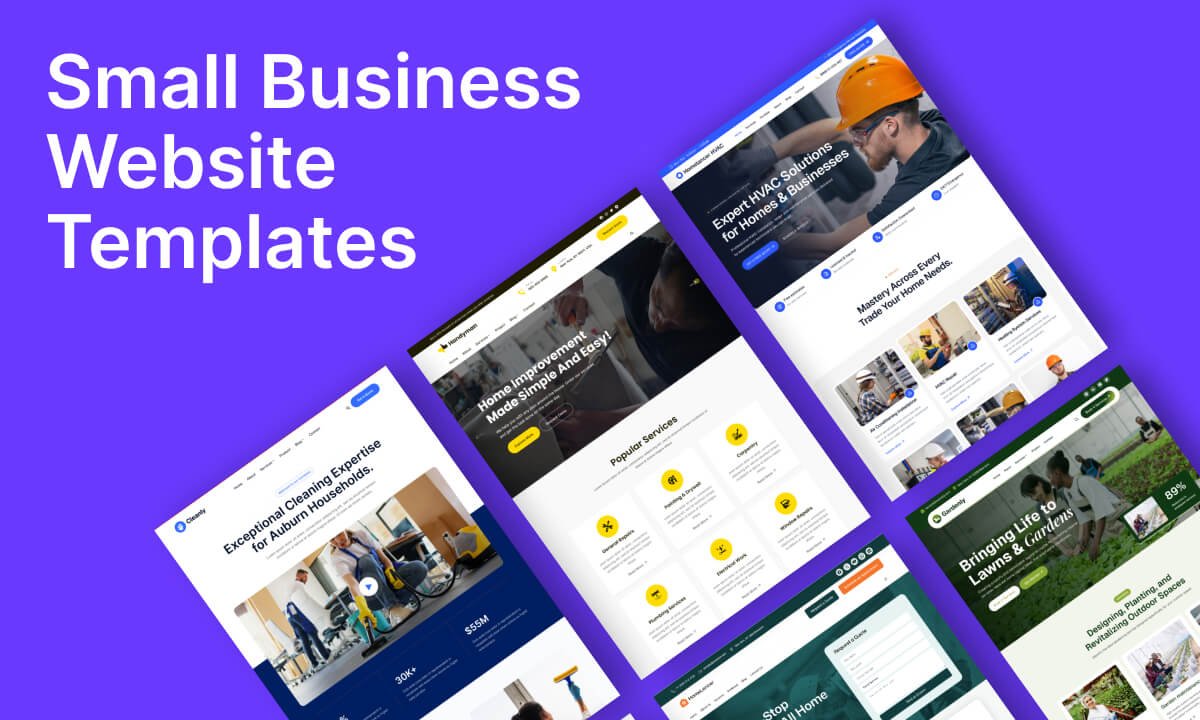
Choosing a website template for a small business is easier when you start with the business rather than the design.
A plumber needs a different website structure from a restaurant. A consultant needs different sections from a landscaping company. A local retailer may care more about products and opening hours, while a contractor may need service pages, project galleries, testimonials, and quote requests.
That is why the best small business website templates are not simply the ones with the most attractive homepages. They are the ones that give you the right structure for your customers, services, content, and goals.
For most small businesses, a professionally designed template can also eliminate a lot of unnecessary work. Instead of starting with a blank WordPress installation and designing every section from scratch, you can begin with a proven structure and customize the branding, content, images, colors, and calls to action.
This guide compares 10 strong options for different types of small businesses in 2026, with particular attention to local businesses, service companies, freelancers, agencies, and home-service professionals.
What Is a Small Business Website Template?
A small business website template is a pre-designed website structure created around the common needs of a small company, local business, freelancer, or service provider.
It typically provides layouts for important areas such as the homepage, services, about page, testimonials, contact information, calls to action, blog, and other business content.
The main advantage is simple: you get a professional starting point without having to design every page from scratch.
The terms template, theme, starter site, and block pattern are related but not identical.
Website template
A template is a pre-designed page or website layout that you customize with your own content.
WordPress theme
A WordPress theme controls the overall appearance and, depending on the theme, parts of the structure and functionality of your WordPress website.
Starter site
A starter site is a more complete starting point, often including multiple pages, templates, navigation, headers, footers, and pre-designed content structures.
Website builder template
A website builder may provide pre-designed layouts that you edit through its visual editing system.
Block pattern
A block pattern is a reusable section made from WordPress blocks. It might be a hero section, testimonial section, pricing table, services layout, or call-to-action section.
For small businesses using modern WordPress, the distinction matters less than the outcome: Can you quickly create a professional website that explains what you do and makes it easy for customers to contact you?
What Should a Small Business Website Template Include?
A good template should help answer the questions customers have before contacting a business.
At a minimum, look for these elements:
1. A clear homepage
Visitors should understand what the business does within seconds.
The homepage should communicate:
- What you offer
- Who you serve
- Where you operate
- Why customers should trust you
- What visitors should do next
A beautiful hero image is useful, but clarity is more important.
2. Services or products
Your services should be easy to find and understand.
For a service company, this could mean dedicated service cards and individual service pages. For a retailer, it may mean product categories and featured products.
3. About section
Small businesses often compete on trust as much as price.
An effective About section can introduce the people behind the company, explain experience, communicate values, and give visitors another reason to choose the business.
4. Testimonials and reviews
Social proof reduces uncertainty.
Customer testimonials, reviews, project results, client logos, certifications, and other trust signals can be particularly valuable for local and professional service businesses.
5. Contact information
Make contact information easy to find.
Depending on the business, that may include:
- Phone number
- Email address
- Contact form
- Physical address
- Service area
- Opening hours
- Booking link
6. Strong calls to action
A business website should guide visitors toward the next step.
Examples include:
- Get a Quote
- Book a Service
- Call Now
- Request an Estimate
- Schedule a Consultation
- Visit Our Store
7. Location and service areas
For a local business, location information is not optional decoration.
A good local business website should clearly communicate where the business operates.
8. Mobile-responsive design
A website must work well on phones as well as desktop screens.
This is especially important for local services because customers may search for a business while they are away from home or dealing with an immediate problem.
9. FAQs
FAQs can answer questions about pricing, availability, service areas, processes, turnaround times, warranties, and other concerns.
They can also reduce repetitive customer inquiries.
10. Blog or content section
A blog can support long-term visibility by allowing businesses to publish useful information, project updates, maintenance advice, announcements, and answers to customer questions.
11. Social proof
Beyond testimonials, consider:
- Reviews
- Certifications
- Awards
- Years of experience
- Completed projects
- Client logos
- Team expertise
12. Fast and accessible structure
The template should provide a clean foundation without making the website unnecessarily complicated.
Performance, readable typography, keyboard accessibility, clear contrast, descriptive links, and a logical content hierarchy all contribute to a better website.
10 Best Small Business Website Templates for 2026
There is no single template that is best for every business.
The following options are selected for different needs, ranging from dedicated home-service websites to flexible WordPress themes suitable for agencies, consultants, retailers, and other small businesses.
| Template / Theme | Best For | Business Type | WordPress | Customization | Ideal User |
|---|---|---|---|---|---|
| HomeLancer | Home & local services | Contractors, plumbers, HVAC, electricians, cleaners | Yes | High | Business owners & freelancers |
| Astra | Flexible business sites | Small businesses, agencies, shops | Yes | High | Beginners & agencies |
| Kadence | Block-editor-focused sites | Businesses, consultants, agencies | Yes | High | Gutenberg users |
| GeneratePress | Lightweight foundations | Businesses, professionals, agencies | Yes | High | Performance-focused users |
| Blocksy | Modern flexible sites | Businesses, stores, agencies | Yes | High | DIY users & designers |
| Neve | Beginner-friendly business sites | Local businesses, freelancers, agencies | Yes | High | Beginners |
| OceanWP | Feature-rich business websites | Businesses, stores, service companies | Yes | High | DIY users |
| Sydney | Business presentation | Small businesses, agencies, freelancers | Yes | High | Business owners |
| Hestia | Modern one-page business sites | Startups, professionals, local businesses | Yes | Medium-High | Small businesses |
| Hello Elementor | Elementor-based projects | Agencies, freelancers, custom business sites | Yes | Very High with Elementor | Designers & agencies |
The first option is intentionally specialized, while the others provide broader WordPress foundations. Current 2026 WordPress business-theme roundups continue to feature options such as Astra, GeneratePress, Kadence, Blocksy, Neve, OceanWP, and Sydney among common business choices.
1. HomeLancer
Best for: Home-service and local-service businesses
If your business provides services at customers’ homes or properties, a generic business theme is not always the best starting point.
HomeLancer by CozyThemes is specifically designed around home-service businesses and contractors. The theme currently targets businesses including handyman services, plumbing, HVAC, electrical, cleaning, roofing, painting, landscaping, renovation, and other home-service categories.
Business types
HomeLancer is particularly suitable for:
- Plumbing companies
- HVAC contractors
- Electricians
- Handymen
- Cleaning businesses
- Landscaping companies
- Roofing contractors
- Painting businesses
- Renovation companies
- Repair services
- Other local service professionals
Key strengths
The biggest advantage is industry relevance.
Instead of adapting a generic agency or corporate layout to a home-service business, you start with a structure designed around services, projects, testimonials, FAQs, pricing, contact information, and calls to action.
The current theme includes ready-made patterns and templates for areas such as headers, footers, hero sections, services, testimonials, pricing, FAQs, portfolio content, and core pages.
CozyThemes also positions HomeLancer around practical business outcomes: presenting services clearly, showing completed work, building trust, and making it easier for visitors to take the next step.
Ideal user
HomeLancer works particularly well for:
- A home-service business owner building their own site
- A freelancer creating websites for contractors
- A small web agency serving local businesses
- A WordPress designer who wants a ready-made service-business foundation
Why it stands out
The main differentiator is not simply visual design. It is business-specific structure.
A plumbing website, for example, needs to make emergency services, repairs, service areas, trust signals, and contact options easy to find. A generic business template may require substantial customization to achieve that.
HomeLancer gives that type of business a more relevant starting point.
Potential consideration
HomeLancer is intentionally focused on home services. If you are building a SaaS company, restaurant, editorial publication, or unrelated ecommerce business, a broader multipurpose theme may be more appropriate.
2. Astra
Best for: Flexible small business websites
Astra is a strong choice when you want a broad WordPress ecosystem and a large collection of starting points.
It can work for businesses ranging from consultants and agencies to local shops and professional services.
Business types
- Agencies
- Consultants
- Local businesses
- Professional services
- Online businesses
- Stores
Key strengths
Astra’s major advantage is flexibility.
It can provide a starting point for businesses that do not fit neatly into one industry-specific category.
Its large ecosystem also makes it attractive to freelancers who build different types of client websites.
Ideal user
Astra is particularly useful when you want:
- A broad template ecosystem
- A flexible WordPress foundation
- Compatibility with different site-building approaches
- A theme that can adapt to different industries
Current 2026 comparisons continue to identify Astra as one of the major lightweight WordPress options and highlight its extensive starter-template ecosystem.
Potential consideration
Because Astra is highly multipurpose, you may need to do more customization to make a site feel specifically designed for a particular local service business.
3. Kadence
Best for: Gutenberg and block-editor users
Kadence is a strong option for businesses that want to work heavily with the WordPress block editor.
Business types
- Consultants
- Agencies
- Small businesses
- Professional services
- Bloggers
- Online businesses
Key strengths
Its appeal comes from combining a flexible theme with a broader block-based website-building workflow.
For businesses that want more control over layouts without relying entirely on custom development, this can be a useful approach.
Ideal user
Kadence is especially interesting for:
- Gutenberg users
- Freelancers
- Designers
- Small businesses building their own sites
- Agencies creating reusable WordPress websites
Recent 2026 comparisons continue to position Kadence as a strong choice for Gutenberg-focused users.
Potential consideration
If your main priority is an industry-specific structure rather than a flexible foundation, a specialized theme such as HomeLancer may require less adaptation.
4. GeneratePress
Best for: Lightweight, performance-focused websites
GeneratePress is a good fit when you want a clean foundation and intend to build the website around your own content and design requirements.
Business types
- Consultants
- Agencies
- Professional services
- Freelancers
- Small companies
- Content-driven businesses
Key strengths
GeneratePress has long been associated with a lightweight approach and is particularly attractive to users who value control and performance.
It can work well when the business owner or developer wants to avoid unnecessary design complexity.
Ideal user
It is particularly suitable for:
- Developers
- Freelancers
- Agencies
- Performance-conscious business owners
- People comfortable building from a relatively clean foundation
Recent 2026 comparisons continue to list GeneratePress among the leading lightweight WordPress themes for business websites.
Potential consideration
A lightweight foundation can mean that you need to make more design decisions yourself compared with a highly specialized starter site.
5. Blocksy
Best for: Modern business websites and flexible layouts
Blocksy is another flexible WordPress option that works well for businesses wanting modern layouts and customization.
Business types
- Small businesses
- Agencies
- Local retailers
- Service businesses
- Ecommerce businesses
Key strengths
Blocksy is particularly attractive when visual flexibility and modern presentation matter.
It can also be considered by businesses that may eventually expand into ecommerce.
Ideal user
Blocksy can suit:
- DIY website owners
- Freelancers
- Agencies
- Designers
- Small ecommerce businesses
Current 2026 comparisons place Blocksy among the major lightweight WordPress options and highlight its combination of customization and starter-site capabilities.
Potential consideration
Its flexibility means you still need to make sure the chosen starter design actually matches the business’s customer journey rather than choosing it simply because the demo looks good.
6. Neve
Best for: Beginner-friendly small business websites
Neve is a practical option for small businesses that want a relatively straightforward starting point.
Business types
- Local businesses
- Consultants
- Freelancers
- Agencies
- Small professional practices
Key strengths
Neve is often included among lightweight WordPress themes suitable for business websites and beginners.
Its broad positioning makes it useful when the business needs a flexible foundation rather than a highly specialized industry template.
Ideal user
Neve is worth considering if:
- You are building your first WordPress website
- You want a straightforward starting point
- You need flexibility across different business types
- You are working with a freelancer
Current 2026 WordPress theme comparisons continue to include Neve among common business and lightweight options.
Potential consideration
For a contractor or home-service business, you should prioritize a template with service-business sections rather than choosing a general theme solely because it is popular.
7. OceanWP
Best for: Feature-rich small business and ecommerce websites
OceanWP is a flexible WordPress theme that can be used for business websites as well as stores.
Business types
- Local businesses
- Service companies
- Retailers
- Ecommerce businesses
- Agencies
Key strengths
Its broad feature set and flexibility make it useful for businesses that may need more than a simple brochure website.
It can be especially relevant if the business plans to combine company information with ecommerce functionality.
Ideal user
OceanWP is suitable for:
- DIY business owners
- Freelancers
- Agencies
- Small retailers
- Businesses with ecommerce plans
It continues to appear in current 2026 business-theme comparisons.
Potential consideration
More options are not automatically better. A small business should still keep the final website focused on the customer’s most important actions.
8. Sydney
Best for: Professional small business presentation
Sydney is worth considering for businesses looking for a polished corporate or professional-services presentation.
Business types
- Small businesses
- Agencies
- Consultants
- Professional services
- Freelancers
Key strengths
Sydney can provide a useful starting point for businesses that need a conventional professional website structure.
It is particularly relevant when the website’s primary purpose is to communicate expertise, services, company information, and contact details.
Ideal user
Sydney can work for:
- Consultants
- Small agencies
- Professional service companies
- Freelancers
- Local businesses
It is also included among business-oriented WordPress options in recent 2026 theme comparisons.
Potential consideration
A professional-services template may need additional customization if the business depends heavily on bookings, emergency calls, project galleries, or location-specific service pages.
9. Hestia
Best for: Modern one-page and small business websites
Hestia can be a useful choice for small companies that want a modern presentation without a large number of pages.
Business types
- Startups
- Consultants
- Freelancers
- Small agencies
- Local businesses
Key strengths
It works well for businesses that can communicate their value through a relatively compact website structure.
A focused one-page approach can be effective when the business has a small number of services and a straightforward customer journey.
Ideal user
Hestia is worth considering for:
- New businesses
- Freelancers
- Consultants
- Small professional teams
- Businesses that prefer a compact website
It remains part of current 2026 WordPress theme comparisons.
Potential consideration
A one-page structure is not ideal for every local business. If you have many services, multiple locations, or substantial informational content, individual pages may provide a better experience and stronger content structure.
10. Hello Elementor
Best for: Freelancers and agencies using Elementor
Hello Elementor is a different type of choice from the more complete business themes above.
It is primarily attractive as a lightweight starting point for websites that will be designed using Elementor.
Business types
- Agencies
- Freelancers
- Custom business websites
- Startups
- Professional services
Key strengths
The main advantage is design freedom when paired with the Elementor ecosystem.
This can make it useful for freelancers and agencies that already have an established Elementor workflow.
Ideal user
Hello Elementor makes the most sense when:
- Your agency already uses Elementor
- You want to create a custom design
- You are comfortable building the site structure yourself
- You need a flexible foundation rather than an industry-specific template
Current 2026 business-theme comparisons continue to include Hello Elementor among common options for Elementor-based websites.
Potential consideration
It is not the same type of ready-made business solution as an industry-specific theme. More of the website structure may need to be created or assembled by the designer.
Which Small Business Website Template Should You Choose?
The answer depends on what you are actually building.
Choose HomeLancer if:
You operate or build websites for:
- Plumbing
- HVAC
- Electrical
- Cleaning
- Roofing
- Landscaping
- Handyman services
- Painting
- Renovation
- Other home-service businesses
Choose a multipurpose theme if:
You need a flexible foundation for different industries or client projects.
Astra, Kadence, GeneratePress, Blocksy, Neve, and similar themes can be useful in this situation.
Choose a builder-focused foundation if:
You are a freelancer or agency with an established website-building workflow and want maximum design freedom.
How to Choose the Best Small Business Website Template
The best template is not necessarily the one with the most demos.
Use these criteria instead.
1. Match the Template to Your Industry
Industry relevance can save considerable customization time.
A restaurant needs menus, reservations, location information, and opening hours.
A contractor may need:
- Services
- Service areas
- Project galleries
- Testimonials
- Quote requests
- FAQs
- Emergency contact information
Start with the structure that matches your business.
2. Check Mobile Responsiveness
Look at the actual mobile version of the demo.
Check:
- Navigation
- Buttons
- Phone numbers
- Forms
- Images
- Typography
- Spacing
- Service sections
A website that looks excellent on desktop but is awkward on mobile is not a good business template.
3. Look for Clear Calls to Action
Ask:
What do I want the visitor to do?
Then make sure the template supports that action.
For a plumber, it could be Call Now.
For a consultant, it could be Book a Consultation.
For a retailer, it might be Shop Now.
4. Make Sure Services Are Easy to Present
If your business sells services, your template should make those services easy to understand.
Each service should ideally have room for:
- Service name
- Description
- Benefits
- Pricing or quote information
- Relevant images
- FAQs
- CTA
5. Check Customization Options
You should be able to change the elements that define your brand:
- Logo
- Colors
- Typography
- Header
- Footer
- Buttons
- Images
- Page layouts
A template should accelerate your website project, not lock you into someone else’s branding.
6. Consider SEO and Performance
Do not choose a template based solely on a demo’s visual appearance.
Your final website’s performance also depends on:
- Hosting
- Plugins
- Images
- Fonts
- Scripts
- Content
- Caching
- Configuration
Choose a clean foundation and optimize the finished website.
7. Check Accessibility
A professional website should be usable by as many people as possible.
Check for:
- Readable text
- Sufficient contrast
- Logical headings
- Keyboard-friendly navigation
- Accessible forms
- Descriptive links
- Proper image alternatives
Accessibility is part of good web design, not a feature to add at the end.
8. Make Sure It Supports Your Content Strategy
If you plan to publish articles, tutorials, case studies, or project updates, make sure the theme provides a good content experience.
A small business website can become a useful resource instead of remaining a static brochure.
9. Consider Future Growth
Your business may eventually need:
- More services
- More locations
- Ecommerce
- Booking
- Team pages
- Portfolio content
- Lead-generation forms
- Additional landing pages
Choose a foundation that will not force you to rebuild the site as the business grows.
10. Consider Who Will Maintain the Website
A template that is perfect for a developer may not be ideal for a business owner who will update the website themselves.
Ask who will manage:
- Services
- Images
- Blog posts
- Contact information
- Testimonials
- Team members
- Pricing
The easier the website is to maintain, the more useful the template becomes over time.
What Makes a Good Website Template for a Local Business?
A local business website has a different job from a generic company website.
The customer is often trying to answer one simple question:
Can this business help me, and how do I contact them?
A good local business template should make the answer obvious.
Location
Clearly show where the business is located.
Service areas
If you serve multiple towns, cities, neighborhoods, or regions, make that information easy to find.
Phone number
A local service customer may prefer to call immediately.
The phone number should be easy to access, particularly on mobile.
Contact details
Provide appropriate contact options such as:
- Phone
- Contact form
- Booking form
- Physical address
Google Maps or location information
For businesses with physical locations, location information helps customers understand where to find you.
Opening hours
Restaurants, stores, salons, clinics, and other appointment-based businesses should make opening hours easy to find.
Reviews
Reviews and testimonials provide important local trust signals.
Service pages
Don’t put every service into one giant paragraph.
Create clear sections or individual pages when the business offers several important services.
Quote or request forms
Service businesses often need visitors to request an estimate.
Make that action prominent.
Local SEO
Your content should naturally communicate:
- What you do
- Where you operate
- Who you serve
Avoid stuffing city names into every heading. Useful, specific local content is more valuable than repetitive location keywords.
Mobile CTAs
A local customer searching on a phone should not have to hunt for the next step.
What About Plumbing, HVAC, Electrical and Other Home-Service Businesses?
Home-service businesses are one of the clearest examples of why industry-specific website templates can be valuable.
A generic small business website might provide an attractive homepage, About page, Services page, and Contact page.
That’s a start.
But a home-service customer often wants more.
They may want to know:
- Do you serve my area?
- Do you provide emergency service?
- How much might the service cost?
- Can I see examples of your work?
- Are other customers satisfied?
- How experienced are you?
- Can I request a quote?
- What happens after I contact you?
That changes the structure of the website.
For example, plumbing website templates should make plumbing services and emergency contact options prominent.
An HVAC business may need clear sections for:
- Installation
- Repair
- Maintenance
- Service plans
- Emergency service
- Service areas
An electrician may need strong trust signals, service categories, safety information, project examples, and contact options.
The same principle applies to:
- Roofing website templates
- Cleaning service website templates
- Landscaping website templates
- Handyman website templates
- Construction website templates
- Home repair website templates
This is where an industry-focused theme can provide a meaningful advantage.
HomeLancer is specifically built around this type of website structure. CozyThemes currently presents it for home-service categories including plumbing, HVAC, electrical, cleaning, landscaping, painting, roofing, and construction.
It also provides layouts for services, portfolios/projects, pricing, testimonials, teams, FAQs, contact sections, blog content, and responsive layouts.
For businesses looking specifically for home services website templates, CozyThemes also maintains a dedicated collection of home-service WordPress themes.
Should You Build Your Small Business Website Yourself or Hire a Freelancer?
There is no universal answer.
The right approach depends on your budget, technical comfort, timeline, and how unique the website needs to be.
DIY
Building the website yourself can offer:
- Lower initial cost
- Faster experimentation
- More control
- Direct ownership
- An opportunity to learn WordPress
The tradeoff is that you need to spend time learning the tools and making design decisions.
A ready-made template can significantly reduce that learning curve.
Freelancer
Hiring a freelancer can provide:
- Professional customization
- Faster implementation
- Better adaptation to unique requirements
- Design assistance
- Technical support
A freelancer can also start from a template instead of building every component from zero.
That can reduce development time and leave more budget for customization and content.
Agency
An agency may be the better choice when you need:
- Brand strategy
- Custom design
- SEO
- Advanced functionality
- Integrations
- Content strategy
- Ongoing growth
Even agencies can benefit from templates.
A strong starter template gives the team a reusable foundation, allowing them to spend more time solving the client’s specific business problems.
The practical takeaway
Templates do not eliminate professional web design.
They eliminate unnecessary repetition.
A business owner can use one to launch faster. A freelancer can use one to deliver client websites faster. An agency can use one as a foundation for a more customized project.
Why Industry-Specific Templates Often Beat Generic Templates
A generic template gives you flexibility.
An industry-specific template gives you relevance.
Neither is automatically better.
The right choice depends on how closely the template matches the customer’s decision-making process.
Consider a plumber.
A generic business template might provide:
Hero → About → Services → Testimonials → Contact
An industry-focused template might naturally lead to:
Emergency Service → Plumbing Services → Service Areas → Projects → Reviews → FAQs → Request a Quote
The second structure is closer to the questions a plumbing customer actually has.
That is the real value of an industry-specific website template.
It is not merely about saving time on colors and typography.
It can save time on information architecture.
Templates vs. Building From Scratch
Building a website from scratch can make sense when the business has highly unusual requirements.
But for many small businesses, it is unnecessary.
A template gives you a starting structure.
You can then customize:
- Branding
- Content
- Images
- Services
- Locations
- Testimonials
- Calls to action
- Navigation
- Typography
- Colors
- Layouts
The result can still feel unique.
The difference is that you are customizing a useful foundation rather than solving every design problem from zero.
For freelancers and agencies, this can make the difference between spending days on repetitive setup work and spending that time on strategy and client-specific improvements.
Frequently Asked Questions
The best template depends on the business type and website goals. For a general small business, a flexible WordPress theme such as Homelancer, Orakus, Astra, Kadence, GeneratePress, Blocksy, or Neve can provide a useful foundation. For home-service businesses, an industry-focused option such as HomeLancer may reduce customization work because its structure is designed around services, projects, testimonials, FAQs, and contact actions.
A good local business template should prioritize location, service areas, contact information, opening hours where relevant, reviews, services, trust signals, and clear mobile calls to action. The best choice is usually the template that matches the business’s customer journey rather than simply the one with the most attractive demo.
At minimum, a small business website should clearly explain what the business does, who it serves, where it operates, what services or products it provides, why customers should trust it, and how visitors can contact or buy from the business. Common sections include Home, Services, About, Testimonials, Contact, FAQs, service areas, and Blog.
Yes. WordPress templates can give small businesses a professional starting point while allowing them to customize content, branding, layouts, and functionality. The important consideration is choosing a template that matches the business’s needs rather than selecting one based only on appearance.
Yes. The level of customization depends on the theme and tools you choose. Modern WordPress themes and block-based tools can allow you to change colors, typography, layouts, headers, footers, images, content, and sections without editing every part of the site manually.
A service business should prioritize service presentation, testimonials, calls to action, contact options, service areas, FAQs, and trust signals. Industry-specific templates can be particularly useful because they often include these structures from the beginning.
Contractors should look for templates that support services, project galleries, testimonials, team information, service areas, quote requests, FAQs, and strong calls to action. HomeLancer is specifically designed for home-service and contractor websites and supports categories including plumbing, HVAC, electrical, roofing, cleaning, landscaping, painting, and renovation.
Yes, but an industry-specific template may be more efficient. Plumbing and HVAC businesses typically need service-focused pages, emergency-service messaging, service areas, testimonials, project examples, FAQs, and prominent contact or quote buttons. Starting with a template designed around these requirements can reduce the amount of customization needed.
For most small businesses, starting with a good template is the more efficient option. Building from scratch makes more sense when the project has highly specialized functionality or a completely unique design requirement. A template does not prevent customization; it simply gives you a proven starting structure.
Final Takeaway
The best small business website templates are not necessarily the ones with the most impressive demos.
They are the ones that help you build the right website for the business.
For a consultant, that might mean a clean professional presentation and a strong consultation CTA.
For a retailer, it might mean product discovery and ecommerce functionality.
For an agency, flexibility and reusable layouts may matter most.
For a local business, location, reviews, services, contact information, and trust signals should be easy to find.
And for a home-service company, industry relevance becomes particularly important.
A plumber, HVAC contractor, electrician, cleaner, landscaper, roofer, or handyman needs a website that makes services, service areas, projects, reviews, FAQs, and contact options easy to understand.
That is why a specialized option such as HomeLancer can be a particularly strong starting point for home-service and local-service businesses. It combines a WordPress block-based foundation with ready-made structures designed around the practical content those businesses need.
For business owners, the priority should be clarity, trust, usability, and leads.
For freelancers and agencies, the priority should be reusability, customization, speed of delivery, and maintainability.
And for both, the best template is the one that gets you closer to a useful business website without forcing you to reinvent the structure from scratch.
If you’re building a website for a home-service business, start with an industry-relevant foundation. If you’re building different types of client websites, choose a flexible WordPress system that gives you room to adapt.
The goal is not simply to launch a website.
It is to launch a website that helps the business get found, build trust, and turn visitors into customers.
Leave a Reply