

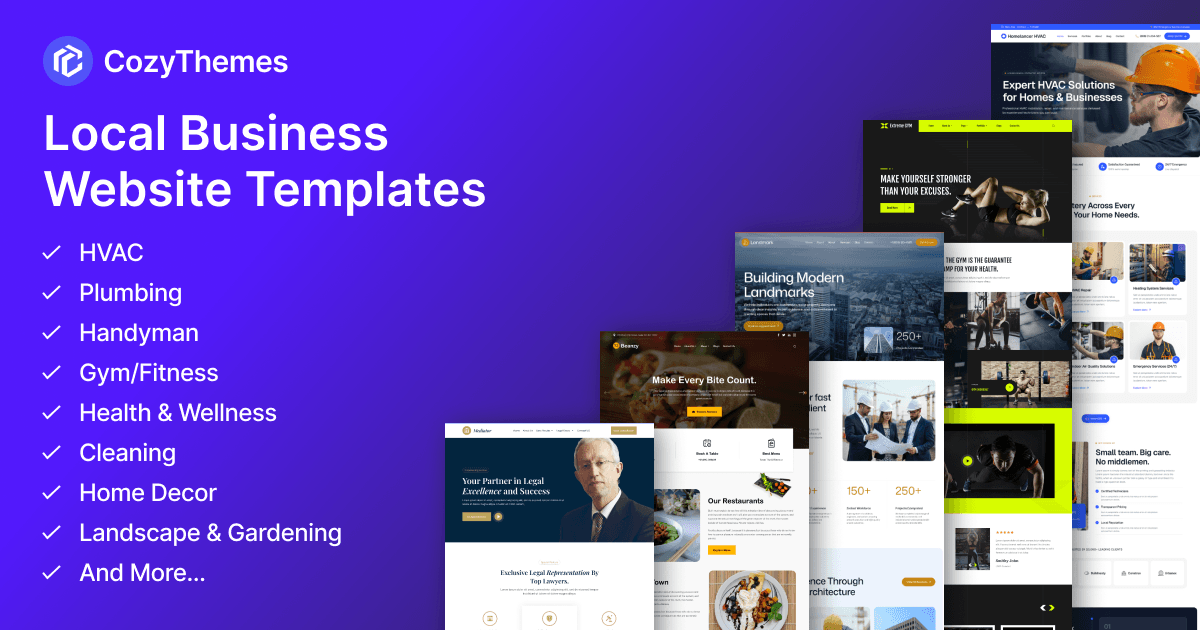
A local customer rarely has all the information they need before deciding to call, visit, book, or request a quote. They may search for a service, compare a few nearby businesses, check reviews, look at services and prices, and then decide which company feels trustworthy.
That makes a local business website more than an online brochure. It needs to explain what you do, show where you work, establish credibility, and make the next step obvious.
This is where local business website templates can help. Instead of starting with an empty page, you can begin with a structure designed around common customer questions and actions, then replace the placeholder content with your own services, branding, photos, service areas, and contact details.
What Is a Local Business Website Template?
A local business website template is a pre-designed website structure created for businesses that serve customers in a specific location or service area. It provides ready-made page layouts, sections, navigation, and visual patterns that can be customized for the business.
Building from a template is different from designing every page from scratch. The template gives you a starting framework, but it does not lock you into someone else’s brand. You can change colors, typography, images, content, sections, services, and calls to action.
For business owners, this can simplify the path to a working site. For freelancers and agencies, it can reduce repetitive design work and provide a reusable foundation.
Why Local Businesses Need More Than a Beautiful Website
A polished design can create a good first impression, but appearance alone does not turn visitors into customers. A useful local business website is built around customer action: visitors should quickly understand the offer, service area, credibility, and next step.
Think of the journey as:
Website → Trust → Contact → Lead → Customer
For example, someone searching for an HVAC company may need to know whether the business serves their neighborhood, handles the type of repair they need, offers emergency service, and can be reached by phone. A page that looks attractive but hides that information creates unnecessary friction.
Good local business website design therefore balances visual quality with service clarity, local relevance, mobile usability, straightforward navigation, and prominent contact or quote actions.
What Should a Local Business Website Include?
A strong local business website does not need dozens of pages. It needs the right information in places where customers can find it quickly.
1. A clear value proposition
The homepage should make three things obvious: what you do, who you serve, and where you operate. “Residential plumbing services in Kathmandu” is more useful to a potential customer than a vague headline about quality or excellence.
2. Clearly presented services
List the main services in language customers understand. A plumber might separate drain cleaning, leak repair, water heater service, and emergency plumbing rather than placing everything under one generic “Services” heading.
3. A strong call to action
Give visitors an obvious next step. Depending on the business, that could be Call Now, Get a Quote, Request Service, Book an Appointment, or Contact Us.
4. Trust signals
Customers want reasons to believe the business can deliver. Useful proof can include reviews, testimonials, years in business, certifications, guarantees, memberships, before-and-after examples, or completed projects. Only show claims and credentials that are genuine and current.
5. Service areas or location
Local relevance matters. Clearly identify the city, neighborhoods, regions, or service areas covered by the business. This helps visitors determine whether the company is actually available to them.
6. An informative About section
An About page should explain who is behind the business, its experience, approach, or values. Local customers often want to know who they are inviting into their home or hiring for an important project.
7. Complete contact information
Make phone numbers, email addresses, physical addresses where applicable, business hours, and contact forms easy to find. Important contact details should not be buried on a single page.
8. A mobile-first experience
Many local searches happen when someone needs information quickly. The website should work comfortably on smaller screens, with readable text, usable buttons, simple menus, and contact actions that are easy to tap.
9. FAQs
FAQs can remove common objections before someone contacts the business. A roofing company might answer questions about inspections, estimates, materials, or project timelines. Keep answers genuinely useful rather than writing FAQs only to insert keywords.
10. Projects, portfolio, or proof of work
Visual proof is particularly valuable for contractors, cleaners, landscapers, painters, remodelers, photographers, and other businesses where the result matters. Real project photos can communicate capability more effectively than generic stock imagery.
What Makes a Good Local Business Website Template?
The best template is not necessarily the one with the most visual effects. Look for a structure that supports the way customers actually choose the business.
A good local business website template should offer:
- Industry relevance: The layout should make sense for the business and its customers.
- Responsive design: Pages should adapt well across phones, tablets, and desktops.
- Clear navigation: Visitors should reach services, contact information, and other key pages without hunting.
- Conversion-focused layout: Important calls to action should have sensible placement.
- Easy customization: Branding, content, images, sections, and layouts should be editable.
- Performance: Avoid unnecessary design elements that make pages heavier without adding value.
- Accessibility: Text, controls, navigation, and other interface elements should remain usable for a broad range of visitors.
- SEO-friendly structure: The template should provide a sound foundation for headings, content, links, and crawlable pages.
- Flexible sections: You should be able to add or remove sections as the business evolves.
- Service-focused content structure: The design should leave room to explain individual services and locations clearly.
A template does not automatically improve search rankings. It provides the foundation. Actual performance depends on useful content, technical implementation, local SEO, business information, links, relevance, and the overall quality of the site.
Local Business Website Templates vs. Building From Scratch
There is no universal winner. The right approach depends on the project’s needs.
| Ready-made template | Build from scratch |
|---|---|
| Faster starting point | Maximum design flexibility |
| Less design effort | Completely custom experience |
| Pre-planned page structure | Structure designed from the ground up |
| Easier to customize than a blank canvas | Potentially more development time |
| Useful for repeat client projects | More control over unique requirements |
For a small business that needs a professional website without a lengthy design process, a template is often a practical starting point. A fully custom build makes more sense when the website requires unusual functionality, a highly distinctive experience, or requirements that a template cannot accommodate.
WordPress for Local Business Websites
WordPress can be a practical platform for local businesses because it combines content management with extensive customization options. Businesses can use themes and templates for the design foundation, plugins for additional functionality, and the WordPress editor for ongoing content updates.
That flexibility is useful as a business grows. A simple service website can later add a blog, new service pages, project galleries, booking functionality, lead-generation tools, or other features as needed.
Local business WordPress themes and WordPress website templates for small businesses can also help owners avoid treating every website update as a completely new development project. The important consideration is choosing a setup that the business can actually maintain.
How to Choose the Right Local Business Website Template
If you are comparing website templates for local businesses, ask these questions before choosing one:
- Does it match the business type? A restaurant, accountant, plumber, and photographer have different customer journeys.
- Is the primary CTA obvious? A visitor should know how to call, book, or request a quote.
- Is it mobile-friendly? Check the actual layouts on a phone, not just a desktop screenshot.
- Can services be presented clearly? Look for room for dedicated service information rather than one crowded section.
- Can the branding be customized? Colors, fonts, imagery, logo placement, and content should feel like the business.
- Does it support local information? There should be natural places for locations, service areas, hours, and contact details.
- Is it easy to maintain? A beautiful site is less useful if ordinary updates require technical help.
- Can it grow with the business? Leave room for new services, locations, content, projects, or functionality.
The key is to judge the template by the business’s customer journey, not just by its demo appearance.
Best Local Business Website Templates for Different Business Types
Different industries need different emphases, even when they share the same basic website principles.
Home-service businesses
Plumbers, HVAC contractors, electricians, roofers, handymen, cleaners, landscapers, painters, and other contractors usually need a highly practical structure. Services, service areas, phone numbers, quote CTAs, testimonials, projects, and emergency-service information where relevant should be easy to find.
A visitor searching for a local electrician should not have to explore several pages just to discover whether the company serves their area or handles the type of work they need.
Professional services
Accountants, consultants, agencies, and other professional firms often need more emphasis on expertise and credibility. Their sites can benefit from clear service descriptions, team information, credentials, case studies or results where appropriate, testimonials, and straightforward contact options.
Local consumer businesses
Restaurants, salons, fitness businesses, photographers, and similar businesses can rely more heavily on visual presentation. Menus or services, galleries, locations, opening hours, reviews, and booking or contact CTAs should be prominent.
The template should reflect the decision customers make. A restaurant visitor may want the menu and opening hours immediately; someone looking for an accountant may care more about expertise and services.
A Ready-Made Starting Point for Home-Service Businesses
For home-service businesses, a specialized starting point can remove much of the work involved in figuring out the basic structure.
Homelancer by CozyThemes is designed as a ready-made starting point for businesses such as plumbers, HVAC companies, electricians, roofers, handymen, cleaning companies, landscapers, contractors, and other home-service providers.
The practical advantage is not that a template replaces strategy. It is that you can begin with an existing service-business structure instead of designing the site from a blank canvas. You can then adapt the content, branding, services, imagery, contact information, and business details to match the actual company.
That makes the approach useful for business owners who want to launch faster and freelancers or agencies building local-service sites.
How to Make a Local Business Website More Effective
Once the template is selected, the real work is making the website specific to the business.
Start by putting the primary service and location clearly on the homepage. Make phone and contact actions easy to find. Create dedicated pages for important services rather than forcing every offering into one crowded section.
Use real customer reviews and genuine project photos whenever possible. Clearly explain service areas, hours, and what customers should expect. Keep important information scannable and make sure the mobile experience is comfortable.
Performance also matters. Compress unnecessarily large images, avoid excessive effects, and keep the page focused on useful content. Maintain accurate business information across the website and create helpful local content when there is something genuinely useful to say.
Most importantly, treat the template as a starting point. A generic template filled with generic copy will still feel generic. The business’s actual experience, services, people, projects, location, and customer questions are what turn the foundation into a useful local website.
Local Business Website Templates: A Smarter Starting Point
A successful local business website does not need to be complicated. It needs to make the right information easy to understand and the next action easy to take.
The right template can speed up development by providing an industry-relevant foundation. From there, the business needs accurate information, useful service content, genuine proof, local relevance, clear CTAs, and a dependable mobile experience.
WordPress gives businesses and website professionals flexibility to customize that foundation and expand it over time. For home-service companies, a specialized option such as Homelancer can make the starting point more relevant to the way plumbers, HVAC companies, electricians, roofers, cleaners, landscapers, and contractors communicate with customers.
Explore Homelancer and start building a professional home-service business website with WordPress.
Frequently Asked Questions
A local business website template is a pre-designed website structure for a business serving customers in a particular location or service area. It typically provides layouts for services, contact information, calls to action, testimonials, and other common sections. The design can then be customized with the business’s own content, branding, images, and information.
A local business website should include a clear value proposition, services, contact information, strong calls to action, trust signals, service areas, an About section, mobile-friendly layouts, FAQs, and relevant proof of work. The exact pages depend on the industry, but customers should quickly understand what the business does, where it operates, and how to contact it.
The best website template is one that matches the business’s industry and customer journey. A good choice makes services easy to understand, places the primary CTA clearly, supports local information, works well on mobile devices, allows branding changes, and can grow with the business. The most attractive demo is not necessarily the most useful template.
Choose a template by checking its industry fit, CTA placement, mobile experience, service-page structure, customization options, local information areas, maintenance requirements, and ability to grow. Before deciding, imagine a real customer arriving from a local search and ask whether they can quickly find the service they need, confirm the business serves them, and make contact.
Yes. A general local business template can be adapted for plumbing or HVAC, but a specialized home-service template can provide a more relevant starting structure. Look for prominent service sections, service areas, quote or call CTAs, testimonials, project examples, and space for emergency-service information when applicable.
Use a template when you want a professional starting point with less design and development effort. Building from scratch is more appropriate when the project requires a highly distinctive design or functionality that a template cannot provide. For many straightforward local-service websites, starting with a template can save time without preventing meaningful customization.
Final Takeaway: Start With the Right Foundation
A local business website does not need to be complicated to be effective. It needs to answer the questions customers have, build trust quickly, and make it easy to take the next step.
The right local business website template gives you that foundation without forcing you to design everything from scratch. But the template is only the starting point. Your services, location, customer reviews, project photos, business information, and useful content are what make the website genuinely relevant to the people you want to reach.
For plumbers, HVAC companies, electricians, roofers, cleaners, landscapers, contractors, and other service businesses, choosing a template built around the needs of home-service customers can make the process even more straightforward.
Start with a strong structure, make it specific to your business, and build the website around what your customers actually need.
If you’re building a home-service website with WordPress, Homelancer by CozyThemes provides a ready-made starting point you can customize for your business, services, branding, and service areas.
Leave a Reply